
When Every Brand Starts Looking the Same (and Why That Should Worry You)
Scroll your feed for 30 seconds.
Go ahead.
Now try to do something surprisingly hard:
Pick out individual brands without seeing their names. Not the obvious ones you already know, but the ones you're discovering for the first time.
Because here's what I keep noticing:
A lot of businesses don't just sound the same anymore… they look the same.
The Brands You Never Confuse (and Why That Matters)
Now think about the brands you actually recognize instantly.
Not because you're studying them. But because your brain already knows them.
You don't need to see their name to identify them. You can scroll and immediately recognize their color palette, their visual style, their tone and layout, their overall "vibe."
It happens in seconds. That's not an accident. That's branding doing its job properly.
Because strong branding doesn't just look nice. It creates recognition without effort.
And recognition is what stops the scroll.
Why Everything Started Blending Together
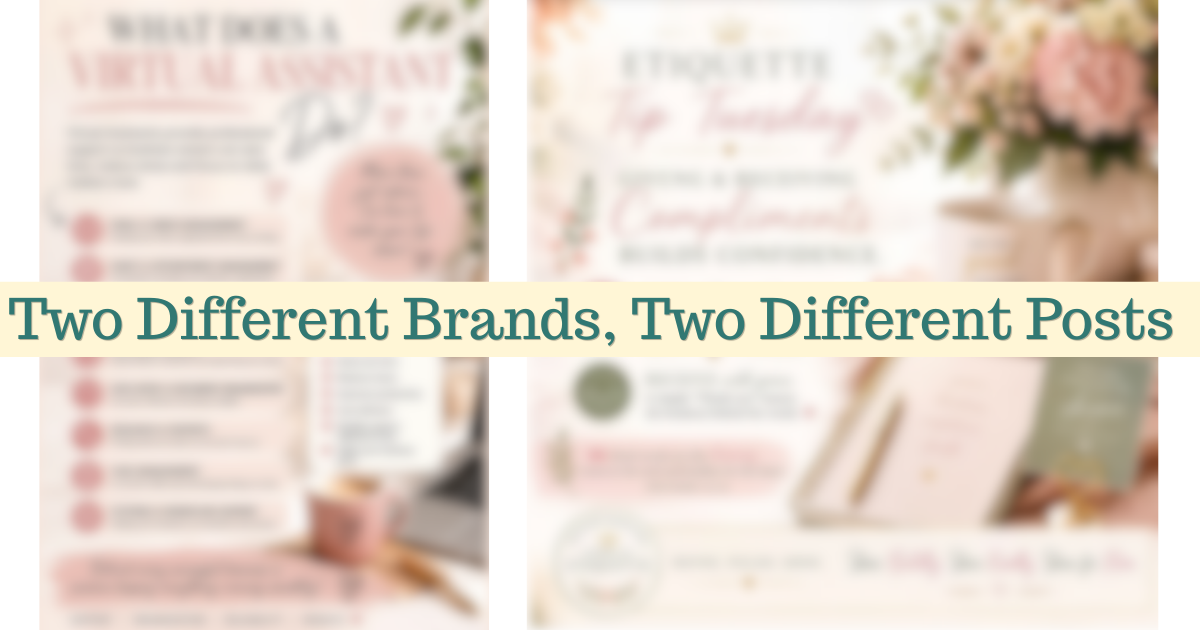
Content creation has become faster, easier, and more automated than ever. AI tools, templates, and pre-built branding kits have made it possible to create polished content in minutes, and for busy business owners, that feels like a lifeline.
But there's a tradeoff nobody talks about enough: when speed becomes the goal, originality usually takes a step back. And over time, that creates something subtle but important: brands that are visually well-designed but emotionally hard to tell apart.
The Problem Isn't AI. It's What We're Using It For.
I'm not anti-AI. As a virtual assistant who works in marketing support, I use it regularly for brainstorming, refining ideas, editing drafts, and helping clients stay consistent when things get overwhelming. It's an incredible tool. But it is still a tool.
The problem starts when tools replace decision-making instead of supporting it. AI can generate content quickly, but it cannot define what makes your brand yours. It cannot convey the heart behind it. That part still belongs to you.
Take More Meaningful Marketing, a mom-run small business I genuinely admire. I can spot her posts before I ever see her name. Her color choices are consistent and intentional, and her overall aesthetic has a warmth that feels unmistakably her. That didn't happen by accident, and it didn't come from a template. It came from someone making deliberate decisions about how she wanted to show up.
That's the difference.
Why This Actually Matters More Than People Think
Audiences are starting to notice. People can sense when content feels overly templated or overly generated, not always consciously, but enough to affect how they engage, trust, and connect.
Because here's the truth most marketing avoids saying directly: People don't connect with "good content." They connect with recognizable content.
They trust what feels consistent, human, and distinct.
And if everything starts to look the same… nothing stands out long enough to be remembered.
So What Actually Makes a Brand Stand Out Now?
It's not perfection. It's not aesthetics. It's not even how frequently you post.
It's recognition.
The ability for someone to scroll, pause for half a second, and think: "I know exactly who this is."
Without checking. Without thinking. Just instinct.
That is what strong branding actually feels like.

Final Thought
So start here: audit your last nine posts as if you're a stranger.
No name, no context, just the visuals and the words. Would you know who created them?
In a feed where everything is starting to look the same, the brands that win long-term won't be the ones that look the most polished.
They'll be the ones you could recognize instantly, without needing a label at all.
If you find your content isn’t matching the brand you’ve worked so hard to create, let’s talk.